
The evolution of media technologies and the globalization have huge impacts on society. With the advent of information age, especially the wide use of the internet and the social media, together with the fast diffusion of the mobile phones, the nearly-instant message transmission and reception have been realized. The time-space compression has reached a new high that we’ve not witnessed before.
The integration of various platforms for information transmission and myriads of means to communicate from ‘one-to-many’, ‘many-to-one’, ‘one-to-one’ and ‘many-to-many’ have tremendously changed the landscape of communication. It is said that the world has become a ‘global village’, in which the information is now shared among the world population. With the exception of some reclusive countries, people in different parts of the world are more connected. We are also becoming more dependent on collective intelligence to make our own decisions. With the enormous changes in society, our personal relationships have also gone through some transformation.
The first major effect is that dependency on direct human-to-human contact has been greatly reduced. The agent for carrying messages is not necessarily needed. Hundreds of years ago, instant communication was unimaginable. In a brief chronicle of international communication, Thussu (2006) introduced the means of information transmission in ancient times, including ‘a line of shouting men’, the writing, the printing and later the postal system. All these communication means inevitably involve the participation of the transportation system and people who operate them.
The invention of the telegraph became an important milestone. Carey (1999, p135) says that ‘the most important point about the telegraph is that it marked the decisive separation of “transportation” and “communication”, because ‘information can be moved independently of and faster than transportation’. At the personal level, people were also librated from the bundle between the transportation vehicles and the messages. The telegraph allowed people to send massages to families or friends as far as the telegraph cable reaches, without the horsemen or the postmen as the agent.
The arrival of the telephone accelerated that change. The telegraph requires messages to be written down, while the telephone can transmit voice directly to the other end. Thus, the back and forth of message exchanges in a few telegraphs can be done in a single conversation. Moreover, the need for a person to walk to the telegraph station to buy the service is no longer needed. From another perspective, the interaction between a customer and an operator ceased to exist in this type of communication.
It’s not only the need for an agent to send messages is cut out from the communication, but also the need for family members, relatives and friends to stay in close proximity has become much less significant. As a result, face-to-face interaction is also much less required for communication. With the broad access to the internet and the wide use of mobile phones, we are now given greater freedom to stay in touch at anytime, anywhere. Especially the convergence of the multimedia applications on a single device, particularly the mobile phone, new communicative means are created. We are now given more possibilities to interact with one another and the flexibility to contact people in any place. Text messages, emails, phone calls, video calls, Facebook newsfeed, Twitter updates can all be done on the mobile phone. This has enabled the mobility in our personal lives and we are now able to organize and re-organize events instantly.

Galvin (2003) points out that the 9/11 terrorist attack is not only a mass-mediated spectacle, but also ‘an instance of the integration of mass media systems and interpersonal telecommunication systems in the constitution of the event itself’ (p.306). The convergence of various forms of communication was particularly reflected on the use of mobile phones. As he (p.312) says: ‘all forms of social event, including terrorist events, are less dependent on planning that must be fixed in advance, and more open to improvisation and self-managed change.’
Given that freedom of contacting people at anytime, anywhere, people are becoming more mobile. The new media technologies provided us with the instant means and various forms of communication. As a result, we can move freely on the planet without worrying about losing contact with our loved ones. The migration of human beings has been gaining strength, as more people cross borders for employment or for political or social reasons. We don’t have to worry about how and how soon to get in touch with someone important on another continent. Our relationships with our loved ones have not changed, but at least it has become much more manageable.
Not only the way a person socializes has been altered, but also the relation of a person to the world has changed. In old times, people were mainly observers of an event laid out in newspapers, radio and TV news. Now we are increasingly becoming participants in the events, whether deliberately or inadvertently.
During 9/11 terrorist attack, though the tourists’ video and voice recordings, phone calls and text messages were casual or personal on the individual level, they have become historical and newsworthy in the context of a major global event. Not only the tourists present at the scene were witnesses of the event themselves, but also the friends, family members on the other end of the conversation were witnesses too, as they had been drawn into the event in real time.
The internet and the social media have magnified this effect. With the ability to communicate instantly and the ability to broadcast to a larger audience, we ourselves are sometimes the source of news. During the Osama Bin Laden raid last May, Forbes (May 2 2011) reported that an IT consultant inadvertently became a witness on Twitter. As he was tweeting about the sound of helicopters and gun fires, he actually became the reporter of the raid. He later jokingly put it: “I’m the guy who liveblogged the Osama raid without knowing it.”
There are some other instances of how users of Facebook, Twitter and Youtube becoming the source of breaking news. The Arab Spring is another instance. When the conventional mass media reporters were barred from entering the country, the protesters posted news, pictures and videos on the social networking sites. That’s how people from outside the region learned what was really happening. In that process, people not present were also drawn into the event in real time and they bore witness to what was taking place.
What has also been highlighted in the Arab Spring is the change in interpersonal relationships: the bonding of activists and the protesters. If the TV, radio and newspapers can be controlled by the government, and telephones can be eavesdropped or interfered, then the internet remains a less intervened territory. This is because the internet as a decentralized medium of communication is very hard to control.
Even a draconian state like China, which exercises strict internet policing, can’t completely stop the internet activism. There were two major internet activist movements in recent years: the call for releasing the actual Beijing air quality measurement data, and the calls for investigation about Wenzhou high-speed train crash. Both movements originated from Chinese micro-blogging site – Weibo.
This new form of communication has altered the way how a person connects with someone else who shares the same beliefs. Rodriguez, Cammaaerts and Audenhove, Taylor (cited in Thussu 2006, p.228) state that ‘the most significant political role that internet has played is in promoting links between community groups, non-governmental organizations and political activists from different part of the world’. If the traditional way of organizing a movement relied on distributing flyers, making phone calls or public speeches, then the internet has increasingly become a new way to form camaraderie. That’s a shift of interpersonal relationships: how we connect with people who share the same ideas, thoughts and beliefs.
Another shift is how we may find friendships with people who do not necessarily live in our neighborhood, but have much more in common with us. Kuo and Chew state that ‘a technologically-savvy Asian middle-class worker and a European one from the same cyber-community may have more similarities between them than they have with a citizen from their own countries of another social-economic status’ (p.433).
We may talk to our Facebook friends, comment on our Twitter followers, login to the internet forums to discuss the topic we are most interested in with the same passionate netizens every day, but we don’t necessarily talk to our co-workers or neighbors in real world that often. What binds us as a community does not entirely depend on the geographical boundary we share, but also about the ideals we share. We may have friends on the other side of the world, without even seeing each other. As long as we share the same ideals, we can still maintain a good relationship, albeit a virtual one.
The internet, the social media and the globalization also have an impact on the shaping of personal identity. People live in different countries are consuming the same media contents, exposed to the same media products and even sharing the same lifestyles. Sardar (2002, p.79) points out that Singapore is the epitome of globalization, and its success ‘…means inculcating globalized manners, mores and values, as seen on TV. Consequently, internalizing global identity means eradicating what comes naturally’; and ‘what is seen on TV takes on an educational meaning; it is the substance of which global success is made. So the children of the elite in newly emerging economies in Asia buy into and act out of the lifestyle of the rich and dominant in the west’ (p.83). This also means that culture is no longer contained in a specific geographical boundary. Kuo and Chew (2009) note that the cultural exchanges brought about by globalization make the cultural identities more dynamic. The migration and the rapid exchanges of cultures have made it difficult to define what a pure Asian culture is, or what a pure western culture is.
This has prompted a change in our relationship with ourselves – personal identity. With the cultural exchanges, one’s self recognition has shifted as well. We cannot always recognize ourselves with a fixed identity. Chitty (2010, p.183) states that ‘the diasporisation of Asia and the West already dilute the categories of Asia and West as intercultural borders become normal transaction venues’. Yue (2006, pp.21-22) cites Ang, Meerwald and Louie’s studies of postmodern Chineseness: ‘tensions arose among overseas Chinese “between historically rooted assumptions about Chineseness as a racial category and changing ways of being culturally, racially, and politically Chinese.”’ Ismail and Shaw (2006) also point out that:
In the world of competing images, internet-driven sharing and exchanging of resources and accessibility to a range of information, it is difficult for Singaporeans not to be exposed to events outside Singapore and not to be ‘influenced’ by them (P.44).
Allan and Luke’s (2000) words can be best to sum up this point:
…identity is a work in progress, rather than a ‘role’ or ‘sense of self’ given by cultures, constructed by individuals, or secured unproblematically from the passing down of residual cultural resources. Identity, then, is a dynamic process … and ‘identity work’ is a conflictual part of everyday life.
A person’s identity is dynamic. That is also to say, a person’s relationship to himself/herself is constantly evolving. The frequent cultural exchanges have expedited the evolvement of one’s identity. It’s not surprising to see people in different continents use the same labels to present themselves.
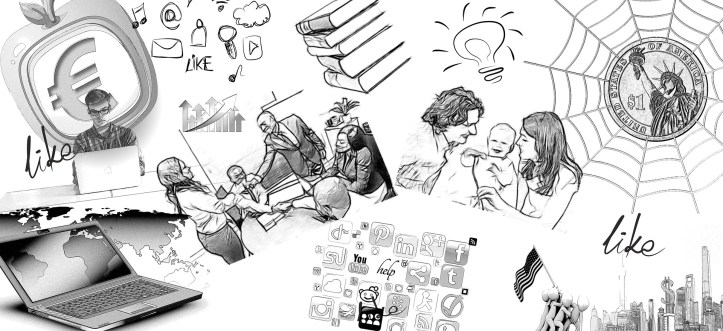
With the help of technologies, we can better manage our relationships with our family members and friends in a long distance; we are now becoming participants of the global events; we can find new relationships on the internet; we can form new bonds with people who share the same ideals. Even our relationship with ourselves has changed: we are re-discovering who we really are. It is undeniable that technologies have changed our way of living and the relationships in our lives.
However, these changes don’t necessarily correspond with either the strengthening or the deteriorating of the relationships. For instance, our classmates, co-workers, or even service providers and bosses can become our friends on Facebook, LinkedIn, but that don’t directly translate into close interactions in real life. As a matter of fact, when it comes to broadcasting ourselves on the social media, privacy settings become necessary. Not everyone is interested in others’ social lives; nor does everyone want the world to know his/her social life. This is why we may block someone’s updates, or selectively update our own status, or update status only to a select group of friends.
As Gu (2010, p.60) says, ‘social and business relationships are intertwined but there are clear, if subtle, rules about perceived abuses or exploitations of these relationships’. In analyzing the key role of the networks, Gu says
These networks are seen to convey ‘sociality’, with, for example, high levels of personal investment, trust and support as the basis of these relationships, providing a sense of belonging and identity, and of creative or aesthetic validation (cf. Banks et al. 2000).
Qiu (2010) also says that ‘the increased freedom does not necessarily mean an overthrow of established relationships’. He also cites Ito et al. and Nakajima et al. as saying
It is more about the re-selecting and re-organizing existing elements of sociability into hybridized structures… which expresses a new level of individual and group agency but on the basis of existing social network patterns (pp.222-223).
Gu (p.64) concludes that
[Social networks] can be restrictive and exclusive. Though this can be characterised as a form of social ‘distinction’ (Bourdieu 1984, Thornton 1996), it can also be about protecting a certain kind of social space… If networking is often about fluid, disembedded individualized social actors, it can also be about being re-embedded into a community of like-minded people, unified around a certain kind of narrative.
That is to say, we join a specific group on the social networks because we think we belong to them, or we share the similar identity of the group. The fundamental elements of human relationships have not changed. Though the ease of communication is provided to us, the need or the will to communicate with someone depends on the strength of the bond, not the communicative capability. In that sense, we can say that the reason for a passenger on United 93 to make a last phone call before the crash, or for a seaman to stuff notes in a bottle before the sinking of Titanic, is very much the same. What drove them to do so is the love for their families, the strong ties between their relationships. Their difference is in the availability of the communication tools.
References:
Carey, J 1999, ‘Time, Space and the Telegraph’, in Communication in History, 3rd edn, eds D Crowley & P Heyer, Longman, New York, pp.135- 141.
Chitty, N 2010, ‘Mapping Asian international communication’, Asian Journal of Communication, vol.20, no.2, pp.181-196.
Galvin, M 2003, ‘September 11 and the logistics of communication’, Continuum: Journal of Media & Cultural Studies, vol. 17, no. 3, pp. 303-311.
Gu, X 2010, ‘Social networks and aesthetic reflexivity in the creative industries’, The Journal of International Communication, vol.16, no.2, pp.55-66.
Ismail R, Shaw, BJ 2006, ‘Singapore’s Malay Muslim minority: social identification in a post- “9/11” world’, Asian Ethnicity, vol.7, no.1, pp.37-51.
Klinenberg, E 2012, ‘Living alone is the new norm’, Time, vol.179, no.10, pp.40-42.
Kuo ECK, Chew, HE 2009, ‘Beyond ethnocentrism in communication theory: towards a culture-centric approach’, Asian Journal of Communication, vol.19, no.4, pp.422-437.
Luke, A, Luke, C 2000, ‘The differences language makes’, in Alter/Asians, ed. L, Ang, Pluto Press, Sydney.
Olson, P 2011, ‘Man Inadvertently Live Tweets Osama Bin Laden Raid’, Forbes Tech, viewed March 7 2011, <http://www.forbes.com/sites/parmyolson/2011/05/02/man-inadvertently-live-tweets-osama-bin-laden-raid/>.
Qiu, JL 2010, ‘Mobile communication research in Asia: changing technological and interlectual geopolitics?’, Asian Journal of Communication, vol.20, no.2, pp.213-229.
Sardar, Z 2002, ‘Globalization’, The A to Z of postmodern life: essays on global culture in the noughties, Vision, London, pp.78-84.
Thussu, DK 2006, ‘The historical context of international communication’, in International communication: continuity and change, 2nd edn, Hodder Arnold, London, pp.1-39.
Thussu, DK 2006, ‘International communication in the Internet age’, in International communication: continuity and change, 2nd edn, Hodder Arnold, London, pp.207-249.
Yue, A 2006, ‘Cultural government and creative industries in Singapore’, Media International Australia, no.107, pp.75-88.
 The Tip Box