I made my second trip to Henan in March 2016, three months after the Xinyang trip. My first stop was Huaiyang, a town lying in the southeast of Zhoukou city and over 200km from the capital city Zhengzhou. Little known outside China, overseas tourists will be surprised to learn that Huaiyang is regarded as the original place where Chinese civilization began. Today, its people still refer to it proudly as “The Dragon Capital” for the town’s historical value.
Now a modern town that focuses on the production of plastic, textile and agricultural products, Huaiyang’s history dates back some 8,000 years. This is significant when comparing the history of cities such as Beijing (1,000 years), Xi’an (3,000 years) and Anyang (5,000 years).
Three different kingdoms were founded here and it was named the country’s capital five times. It was also the choice of two important pre-historical figures – Fuxi and Shen Nong.
Taihao Fuxi Mausoleum
The biggest attraction in Huaiyang is Taihao Fuxi Mausoleum. It is dedicated to Fuxi, the legendary creator of the Chinese civilization.

This National Scenic Area, which has been placed under state protection as an important cultural relic site, is never short of visitors from all over China as well as overseas. The mausoleum is very well preserved despite its age. It was first built in the Spring and Autumn period (770BC – 476BC) and then expanded during the Tang (618 – 907) and Song dynasties (960 – 1279).
During different periods of history, the mausoleum received a lot of attention with public funds poured into its maintenance. The last major repair and restoration work was carried out in 1745 under the imperial order of the Qianlong Emperor in the Qing dynasty (1644 – 1912).
The massive mausoleum occupies over 583,000m2 and consists of a cluster of palace style buildings, a great number of halls, a Tablet Forest and a garden. It is divided into two main parts: the inner city (or the Forbidden City) and the outer city (or the Imperial City).
The buildings at the mausoleum carry the architectural characteristics of the Ming dynasty (1368 – 1644). Evergreen cypress and pine trees line on both sides of the paths leading to each hall and building, while the courtyards are filled with steles and stone tablets.
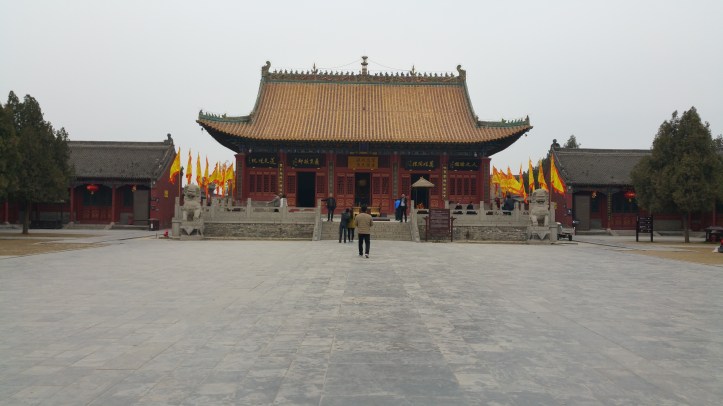
Every piece of architecture at the mausoleum is carefully designed. The mausoleum is guarded by ancient walls and three grand gates: Wuchao Gate (south gate) that serves as the main entrance, Dongtian Gate (east gate) and Xitian Gate (west gate).
Built in the Ming dynasty, Wuchao Gate has single eaves and a gable wall. In accordance with the Chinese emperor’s ruling system, the red gate is three rooms wide, one room deep with nine rows and nine lines.
Through the Wuchao Gate, I was led to a paved stone path that’s also the central axis of the mausoleum. Just a few minutes’ walk away, three stone bridges span across the Yudai. (It means Jade Belt in English.) Each bridge faces one of the three gates: Wuchao, Dongtian and Xitian.
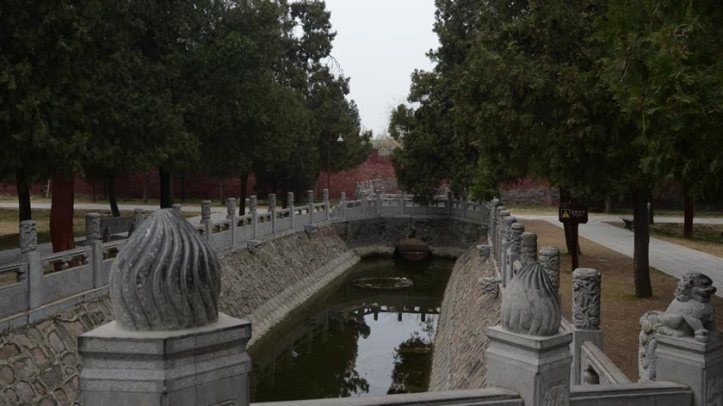
Past the other pair of gates – Daoyi Gate and Xiantian Gate – is the Taiji Gate Square. The big square measures 73m long, 66m wide and is the center of the mausoleum. Two other gates on the two sides lead to the east and west wings, while another grand gate in the front, Taiji Gate, leads directly to the main hall – Tongtian Hall.
The largest building of the mausoleum, Tongtian Hall is a shrine that houses the statue of the legendary Fuxi, alongside four other statues – Shen Nong, Yellow Emperor, Shao Hao and Zhuan Xu. They are together referred to as “the Five Kings”.
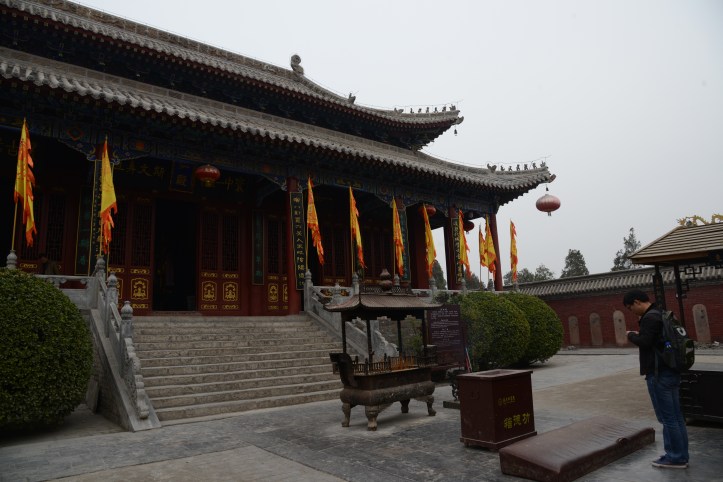
In Chinese mythology, there are “Three Emperors and Five Kings” who are the most important rulers in ancient China. Top among them is Fuxi. He led the transition from the matriarchal to the patriarchal society and is considered as the founding ancestor of the Chinese civilization and therefore, the ancestor of all Chinese people. “Taihao” is the title given to Fuxi, which means his achievement shines like the sun and the moon.
The main hall is packed throughout the year with visitors paying their respects. Behind it is the Tomb of Fuxi. The tomb, 20m tall, 200m wide, rounded at the top with a square base, offers an intriguing tale.
All the Chinese tombs before the Ming dynasty were square shaped. But when Zhu Yuanzhang became the first emperor of the Ming dynasty, the tradition was changed and tombs became round shaped. Zhu Yuanzhang believed that since Fuxi was the supreme Chinese emperor, his square-shaped tomb should remain untouched.
This show of respect to his ancestor means that this is the only tomb in China that has two different shapes.
Tablet Forest
Taihao Fuxi Mausoleum is not all about ancestor worshiping. After paying homage at the Tongtian Hall and the Tomb of Fuxi, I entered another main attraction – the Tablet Forest.
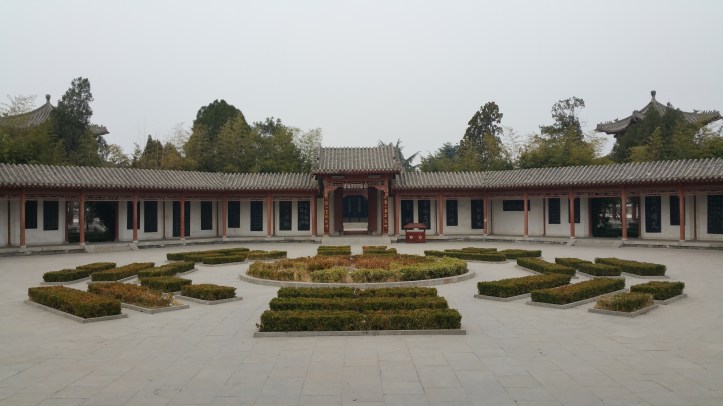
The forest is a delicately designed Chinese garden consisting of the East Corridor, West Corridor, North Corridor and an Octagonal Gallery that houses hundreds of stone carvings and Chinese calligraphy.
Collected over the course of 20 years, these works are from political leaders, historical figures and renowned calligraphers from Hong Kong, Macau and Taiwan. Each tablet features a unique style and the calligrapher’s personal touch, making the forest a cultural gem.
The forest is also well laid out with bamboo and cypress trees surrounding the paths and corridors, forming a pleasant view of a typical Chinese garden.
Duxiu Park
Other than history, the mausoleum also features a visually refreshing garden – Duxiu Park.
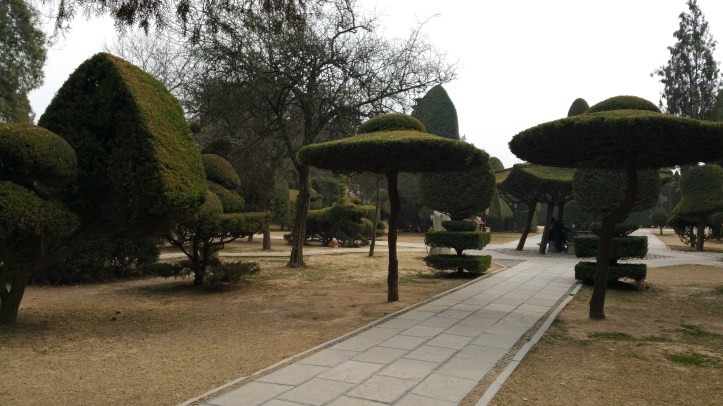
The park is well worth its name “Duxiu”, which literally means “unique show”. Built in 1957, it is the only park in China that strictly uses cypress and pine trees which are pruned into over 200 different shapes, from the 12 animals of the Chinese zodiacs to pagodas and pavilions.
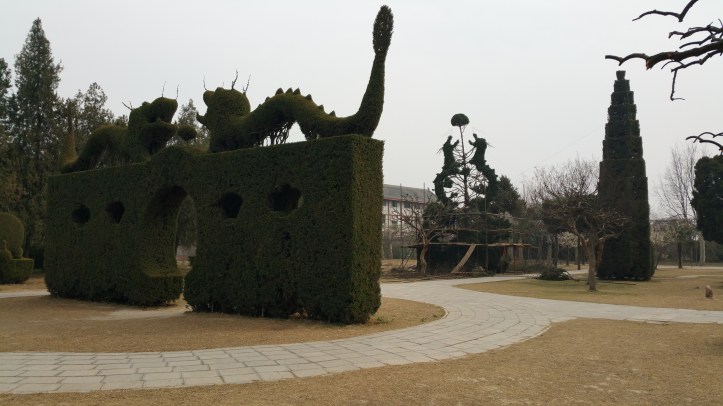
As the cypress and pine trees are evergreen despite the four seasons, the park attracts many tourists and photographers.
Huaguatai
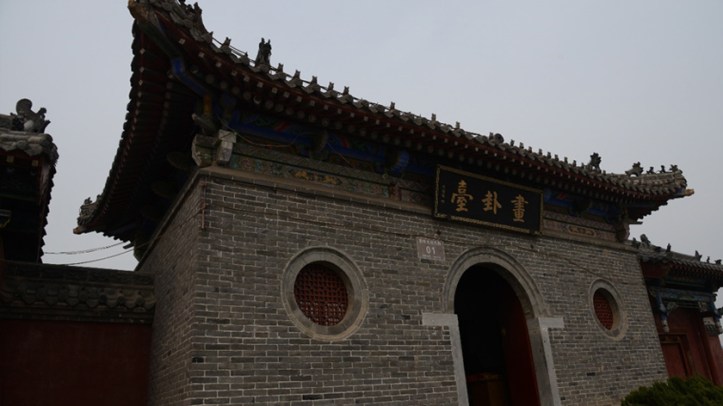
Just a few minutes’ walk from the mausoleum is another site of historical importance in ancient Huaiyang. Once an islet in Longhu (the Dragon Lake), Huaguatai is where Fuxi is said to have created the symbol of Bagua, or Eight Diagrams.
According to legend, Fuxi once caught a white turtle on the islet and created the Bagua based on the marks on the turtle’s shell.
Bagua’s profound meaning lies in its emphasis on harmony, or the balance between yin and yang in the universe. Although Huaguatai is a small shrine, a tour of the area will uncover many fascinating aspects of the Chinese culture and the concept of Bagua.
The Eight Diagrams Pavilion, which stands right behind the main gate, was built in the early years of the Ming dynasty. In the following three centuries, it was destroyed twice – once during the wartime in 1928 and another by a 1994 tornado. But it was rebuilt each time and is preserved until today.
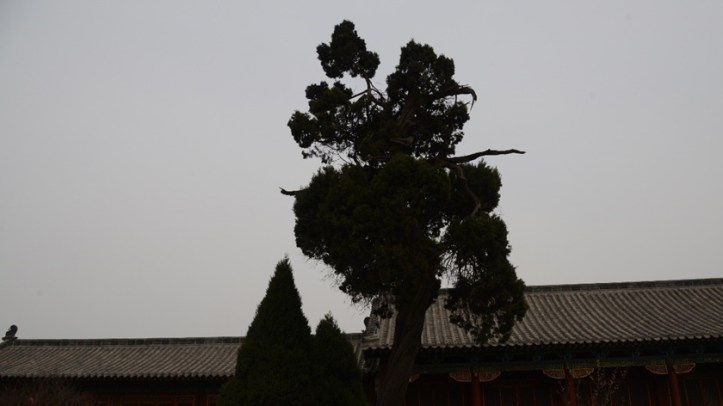
There is also an Eight Diagram Cypress. The oddly shaped tree has been healthy for over 1,000 years, leading people of Huaiyang to believe that it was planted by Fuxi.
The Flavor of Huaiyang
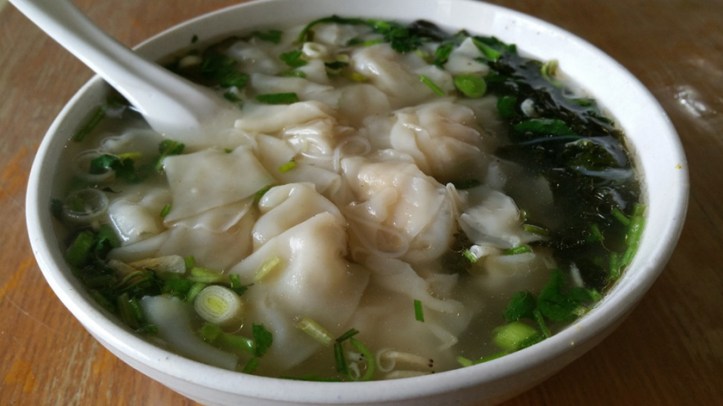
Dumplings are typical food in Henan, and I paid attention to those in Huaiyang.
At a restaurant across the road of Taihao Fuxi Mausoleum, I ordered a bowl which cost only RMB8 (AUD1.65). The dumplings came with very fine skin and marinated pork fillings.
While these were nothing special, the soup that they were soaked in made a key difference. The soup was filled with a copious amount of seaweed, spring onion and other seasonings, making it a bowl of mixed flavors that were hard to resist.
 The Tip Box