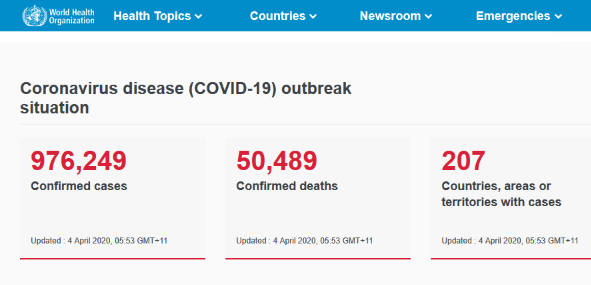
Three months – that’s what it takes for a virus that emerged from a wet market to become a global health crisis. First reported in Wuhan in December 2019, coronavirus has now spread into 207 countries, infected more than 976,000 people and caused over 50,400 deaths.
In the global fight against the invisible enemy, Asia has achieved some success. Despite their geographic proximity to China and more frequent people exchange, Hong Kong, Taiwan, Singapore have kept the virus at bay. Japan has managed it well too. Even South Korea, which initially saw an exponential increase of cases, quickly turned the tide and slowed the spread into a trickle.
In comparison, western countries are struggling greatly to keep it under control, though they had two months to prepare themselves before the virus spilled into their borders. US and Europe, which are far away from the original epicenter China, have become fierce battlegrounds against the deadly virus. And so far, they appear to be on the losing side.
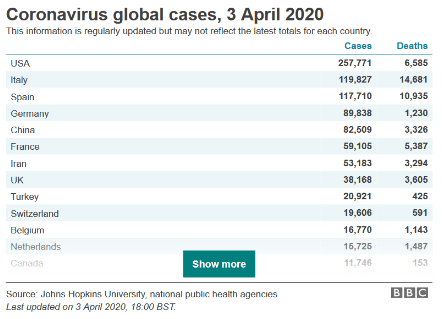
Interestingly, the Asian countries/territories did not enact harsh lockdown measures or force large-scale shutdowns of shops and restaurants. Western countries placed strict restrictions, but situation continued to deteriorate.
Government response played a part, but it also has something to do with the collective consciousness of the society.
When the coronavirus broke out in the Asian countries/territories, people there acted quickly to protect themselves. Donning masks soon became the social norm without governments issuing orders.
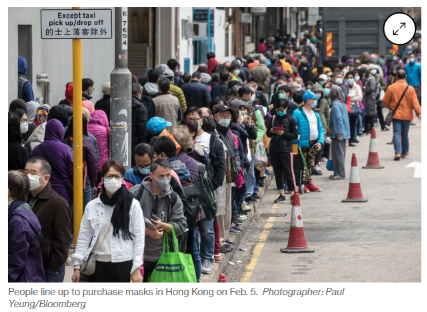
That was partly because they learned a lesson from recent history. These countries/territories were either affected by SARS in 2002-2003 or MERS in 2015. That a communicable disease is a major threat has been built into their collective mind-set, enabling them to act swiftly to avoid a similar tragedy.
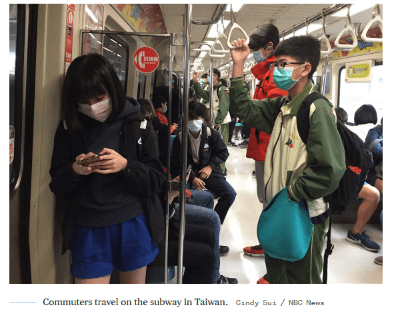
In east Asia (bar Singapore), it is also commonly recognized that a mask not only protects the person behind it, but also people around it. It goes two ways: the wearer shields himself from potential infection; in the meantime, he prevents infection to other people if he falls sick. (Singapore government just announced that it would no longer discourage wearing of masks last evening, 3 April.)
That is a different concept in western countries. In the west, people generally don’t feel comfortable interacting with someone in a mask, as the wearer’s face and expressions are hidden from view. There is also the misconception that wearing a mask is a sign of sickness.
Since Melbourne’s coronavirus situation became serious in February, I haven’t seen many people wearing masks out there – not even in the crowded CBD, where office workers, shoppers and tourists often clog up the pavements. The sporadic mask wearers that I spotted were all Asians and I couldn’t tell if they were locals or tourists.
Though each country introduced social distancing rules in one form or another, people in Asia abode them and could go about their lives, albeit with some restrictions. But many people in the US and Europe ignored or even openly defied them. Governments had to resort to drastic measures such as total lockdowns to combat the surging infections.
The same thing happened here in Australia. (The crowds on Bondi Beach and St Kilda Beach!)
There is an underlying reason for this difference in behavior. Asian countries, regardless of democratic or authoritarian ones, have a stronger sense that collective interests of the society are greater than those of individuals. In western countries, individual rights are fundamental values. State interference is often viewed as big government and unpopular.
This is how western countries have been run – a laissez-faire leadership that gives much freedom to its people to act in their own interests. In normal times, that wouldn’t be an issue. Except these are not normal times and we are dealing with a major health crisis that could threaten our very existence.
Our human brains are unable to register a threat if danger is not imminent. Smokers light up cigarettes every day knowing that it harms their health and can possibly cause cancer. Just like them and many others, I did not take the risk of coronavirus seriously enough. I knew it was lurking somewhere but treated it as a distant reality.
When Victoria state government announced stage two restrictions last weekend (22 March), our company immediately made the arrangements for everyone to work from home the following Monday. But I chose to go to office, thinking that with bigger screens, faster internet speed and all office equipment in one place, I could get things done faster and produce more results. I foolishly thought that the virus would leave me alone as long as everybody around me looked fine.
That was until I learned that healthy-looking people could be carrying the virus too before any symptoms manifest. I suddenly realized that those who appear to be fine could be a risk to me and in that sense, I could be a risk to everyone around me even though I seem healthy.
Last Friday (27 March), I started to work from home as well. (I’m grateful to our company which made it happen almost instantly.) Yes, it is a pain to work on a smaller screen; it is harder to download and upload files when accessing servers remotely; it is an annoyance to have limited space on my hard drive. I get it all. But I know that I am no longer acting irresponsibly by going out every day, exposing my loved ones to a risk they otherwise wouldn’t be.
To the beach goers and those who think the way I used to, I know that restrictions of movement are a lot of pain and grossly affect the way we live our daily lives. And I understand all these restrictions hurt our economy and impact our livelihoods. But we need to adjust to the reality that a bigger threat is right in front of us and if we don’t do our part to confront it, it could make our lives worse than they already are.
If our community is lost, then there won’t be any individual rights left; if half of the population is sick or struggling to stay alive, then there won’t be an economy to live with.
 The Tip Box