Lingshan Mountain was the last stop I made on the trip to Xinyang city in December 2015. I am not into any religious tourism, but the trip turned out to be much more fun than I expected.
As the origin of Buddhism in China, Henan is not short of Buddhist temples. But unlike other places in Henan or the rest of China, Lingshan Mountain is the only one that houses both monks and nuns – that is very rare among Buddhist sites.

In ancient times, there were seven temples and three convents in the mountain. Relics of some of these places can still be seen. One of them and the main feature of the mountain, Lingshan Temple, was first built in the Tang Dynasty (618 – 907). Today, it is well preserved and well-known in China for its “special” power.
Lingshan Temple
Locals proudly shared with me that every wish that was made at the temple had always come true, hence the name Ling, which means “efficacious”. (Shan is the Chinese word for “mountain”.)
As word spread all over the country, many people made the special trek to the temple to seek answers. Every year, the temple sees over 300,000 visitors, many with hopes for their prayers to be answered.
Some even travel thousands of kilometers here to seek luck at the temple, which has been a place of royal refuge.
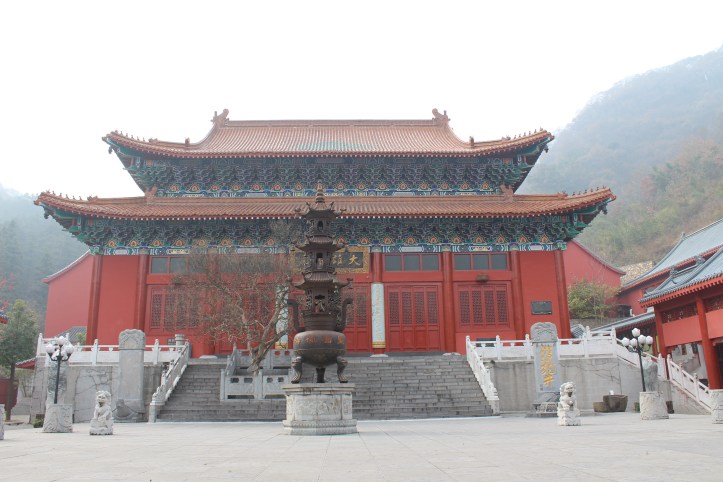
First built in 474, Lingshan Temple has over 1,500 years of history and is regarded as one of the four largest ancient temples in central China. In the Tang Dynasty, it was named the National Temple, where the daughter of the seventh Tang Emperor Xuanzong became a Buddhist nun.
Legend has it that on the day the princess entered the monastery, she planted a ginko tree at the south wall of the temple. Today, the ginkgo tree remains standing in the yard with red ribbons fluttering in the wind.
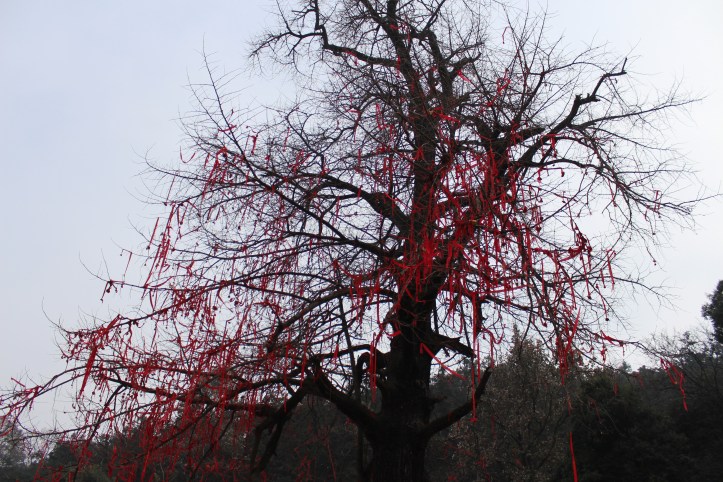
If legend is true, the tree is over 1,000 years old. Though I was there in winter, the tree looked perfectly healthy, and photos showed it has luxuriant foliage in spring and summer. The tree has become the symbol of the Lingshan Temple. The red silk on its branches are the wishes of each person that has stood under it.
The scenic temple that rises amid lush mountain forests was also significant to the first emperor of the Ming dynasty (1368 – 1644), Zhu Yuanzhang. Having lived his early life as a monk, Zhu Yuanzhang became a powerful commander who led the overthrow of the Yuan dynasty (1279 – 1368) established by Kublai Khan (the emperor depicted in the hit Netflix series Marco Polo).
Zhu Yuanzhang sought help from the monks at Lingshan temple when he was besieged by enemies. After he established the Ming dynasty and became Emperor Hongwu, he paid homage to the place.
Today, a copy of his handwritten tablet can still be seen in the main hall of the temple.
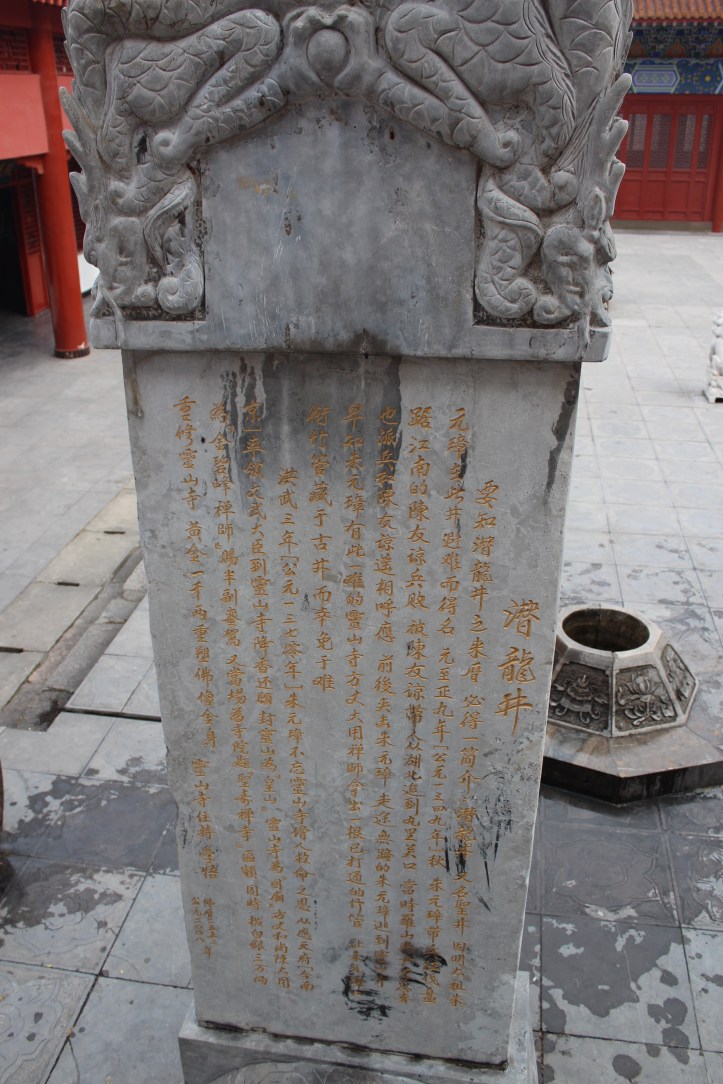
In the middle court of the temple, there is a well named Qianlong Jing (Well of the Hidden Dragon). Zhu Yuanzhang is said to have once survived the manhunt by hiding in the well. It is also called Sheng Jing (Sacred Well) and attracts many tourists today who often throw coins into the well to wish for good luck.
Standing right in front of the temple hall is a jacaranda tree, which has become an attraction. Planted during the Qing dynasty (1644 – 1911), it is more than 300 years old and draws both the curious and the wish-seekers because of its amazing ability.
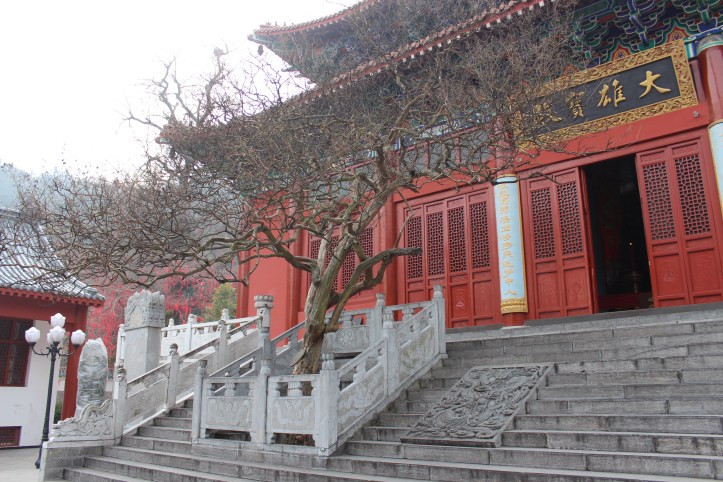
When I visited there, the tree looked ordinary, as it does on most days. But between mid-May and end-August, the tree transforms itself and radiates with red flowers. The blossoming period runs like a ritual and the tree has done so for the past 300 years.
The flowering takes place for about 100 days. Because of this, the tree is also known as “Hundred-Day Red” (Bai Ri Hong).
Other attractions
As a national scenic area, Lingshan Mountain features many other attractions. Most of them are centered around Buddhist teachings and beliefs, but the sites are interesting too for casual visitors such as me.
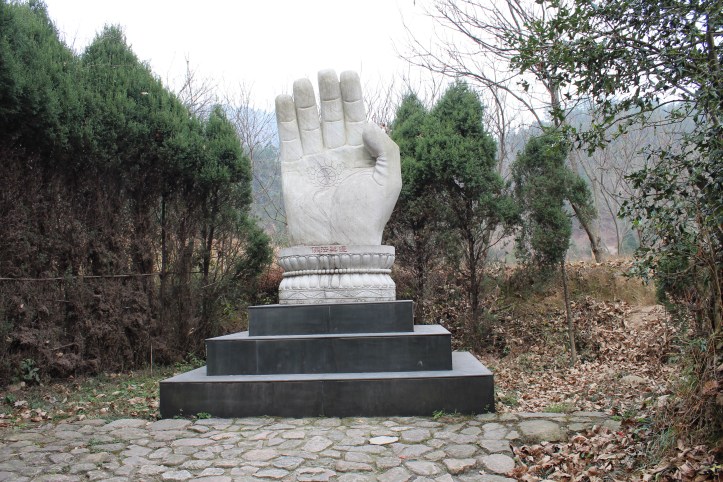
Immediately after entering the gate of Lingshan Mountain Scenic Area, I was greeted by a majestic scene of the hand of the Avalokitesvara’s (Guanyin Buddha) holding a vase. On either side, the Eighteen Arhats with different gestures guard the passageway.
The water from the vase flows down to a pond under the lotus pedestal and then streams into the man-made lake in the front. The lively presentation of Chinese Buddhism beliefs is important to some visitors who believe that when they touch the water, they become blessed.
One the way up to the Lingshan Temple, a statue of Zhu Yuanzhang who became the first Ming emperor stands on top of a hill. The stairway leading up to the statue is steep and long, but many Chinese history fans climb these stairs to pay respects to Zhu Yuanzhang, who was one of the most reform-minded emperors in China.
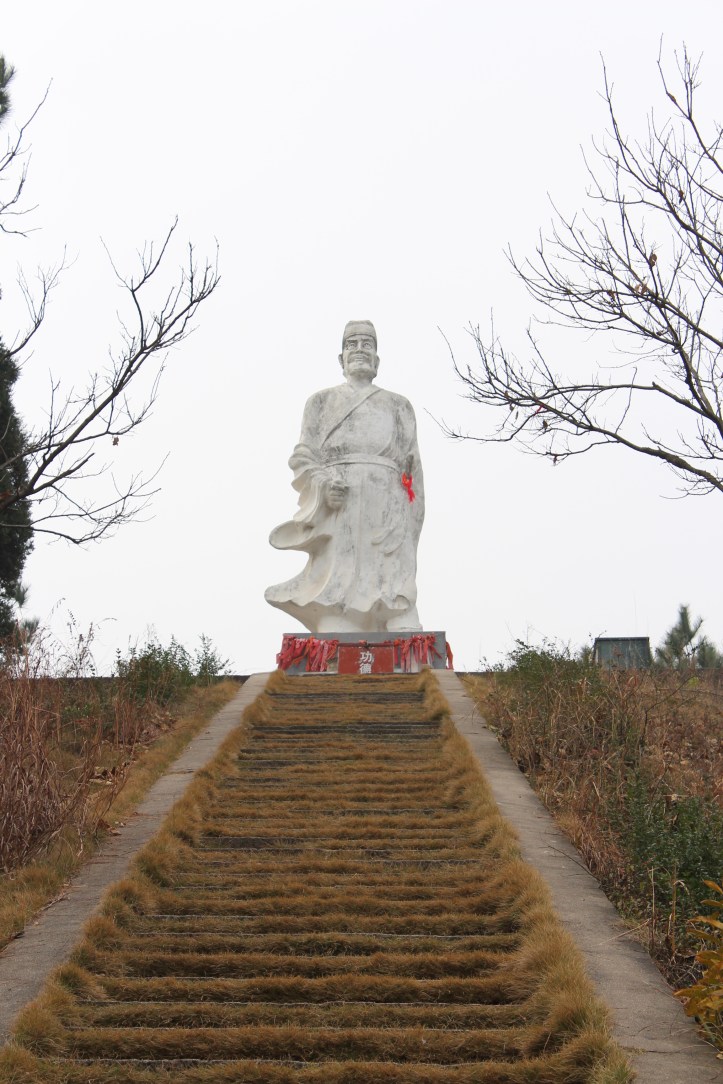
During his reign, China was peaceful and prospering. The period is also famously known as “The Prosperity Age of Hongwu” in Chinese history.
Right behind the statue is the Yuanzhang Lake. The bridge that connects the two sides is completely made of wood. For safety reason, visitors are asked not to shake it or jump on it. But it felt quite sturdy when I walked on the bridge.
Beside the Yuanzhang Lake, there is a spot for amusement with an interesting weight measuring mechanism. The path is blocked by 13 stone pillars. Each gap between the pillars is of different width and carries a red tag above it. Some tags come with encouragement, such as “you better lose some weight” or “it can’t get any better”.
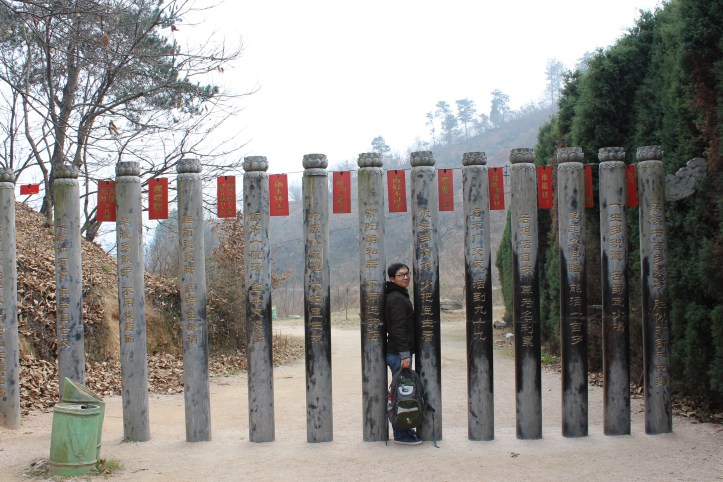
After getting through the gap, a short walk brings me to two dividing paths. They are reminder of life, and the importance to stop and think carefully before treading down a path.
There are square and round stones on the paths. Every square is inscribed with words describing good deeds in Buddhist teachings, while the round stones are inscribed with description of evil deeds.
But should a person choose the path of evil, the journey won’t be long. Mid-way down the path a hand appears with the words “Buddha’s power is boundless” (Fo Fa Wu Bian). If only life was that simple!
Further up and next to the Lingshan Temple gate is the Forest of Sun and Rain (Qing Yu Lin). The forest mostly consists of maple trees and got its name because the trees are often covered in dew.
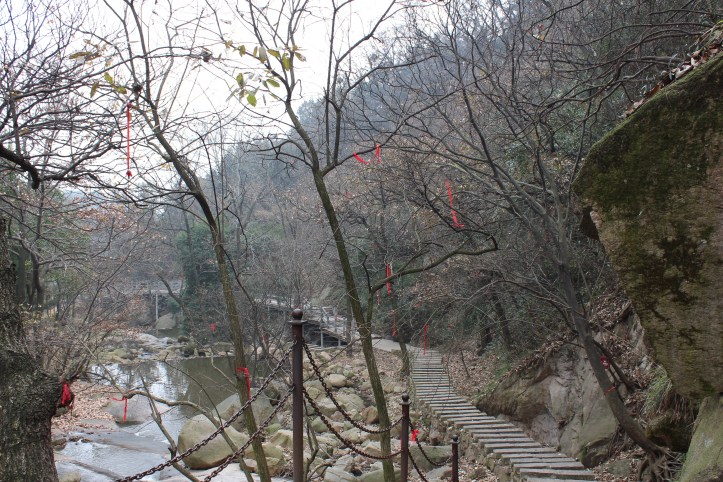
Locals also call it the “Forest of Yearning” (Xiang Si Lin), or “Forest of Tears” (Hui Lei Lin). Because of the constant dew, the forest is popular for summer walks as it is naturally cool.
Next to the forest stands a raised platform with five bronze bells, each with a special meaning.
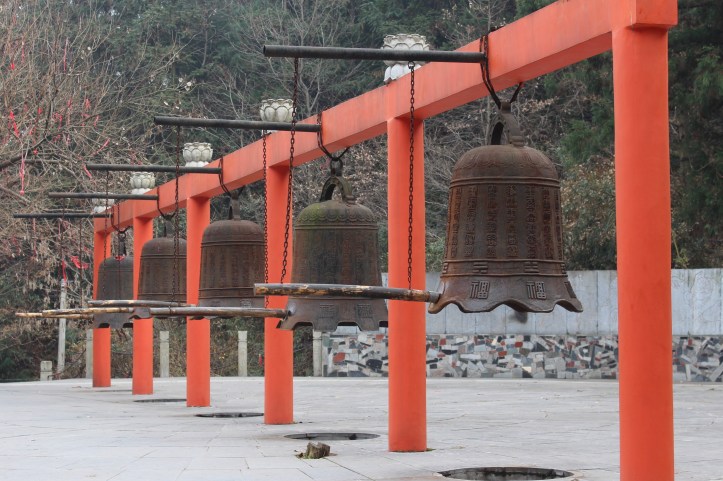
The first bell is the Bell of Happiness. Strike it three times and you’ll get blessed by Three Lucky Stars. The second one is the Bell of Fortune. You must sound six rings as six is a lucky number in Chinese. The third is the Bell of Longevity and it must sound with nine rings. The fourth one is the Bell of Joy. Only two rings is needed, “double joy comes to your door” as the Chinese saying goes.
The last one is the Bell of Wealth. But no matter how hard I struck it, the ring was muted. It was intentionally made this way because the Chinese believe one should not brag about his wealth. Locals asked me to strike it four times anyway as that symbolizes “wealth comes in all four seasons”.
And with that, I felt contented.
 The Tip Box