Origin of Maojian
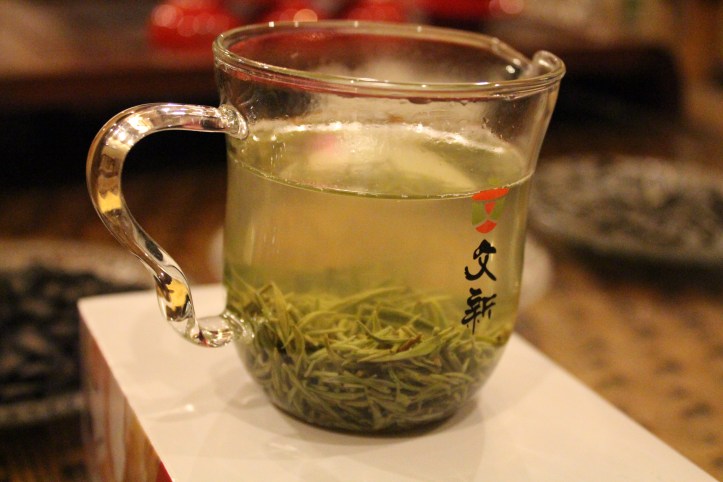
The meaning behind the name Maojian lies in the appearance of the tea leaves. Compared with other types of green tea, Maojian tea leaves are smaller. When brewed in hot water, the leaves look like tiny fuzzy tips in a cup, and thus the name “Mao” (fuzzy). With the shape of the tea leaves which have delicate edges and a thin and rolled appearance, comes the word “Jian” (sharp or pointed).
At the height of Xinyang’s tea trade, there were a number of famous tea shops founded over 100 years ago. Although coffee outlets are gaining popularity in China these days, it is easy to find a good cup of Maojian in Xinyang.
Most tea production in the city is taken up by local brands that account for a big chunk of the market share. These tea companies mainly deal with premium quality Maojian and sell it in exquisite boxes or elegantly wrapped packages.
One of the biggest tea companies in Xinyang is Wenxin Maojian Tea. It has sales operation all over China and has stores in Hong Kong as well. The tea at its flagship shop sells from RMB100/kg (AUD21) on the lower end, and between RMB1,000-2,000/kg (AUD208-417) in the middle range.
Farmers are required to take special care of these trees and monitor them regularly. Only the young buds of leaves during the short period between April and May are plucked, while two processing steps are taken to dry the leaves, including the natural way and a modern method that involves a specially designed drying machine.
For the record, only the natural way of drying is used in conventional tea production and lots of small tea shops today still use the same method to make Maojian tea.
A taste of Maojian
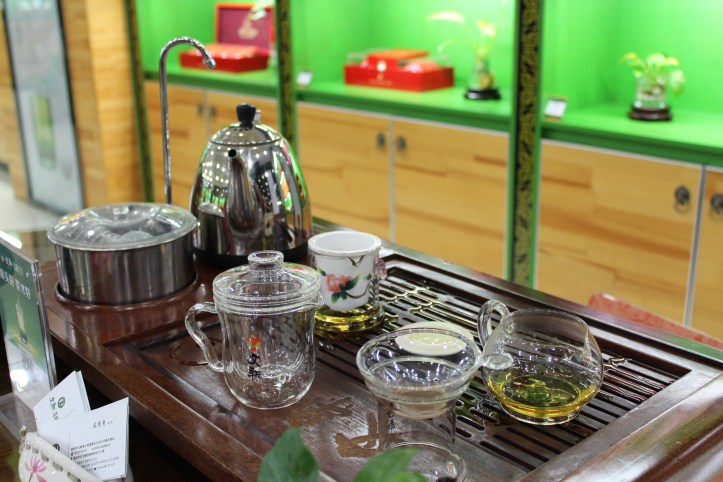
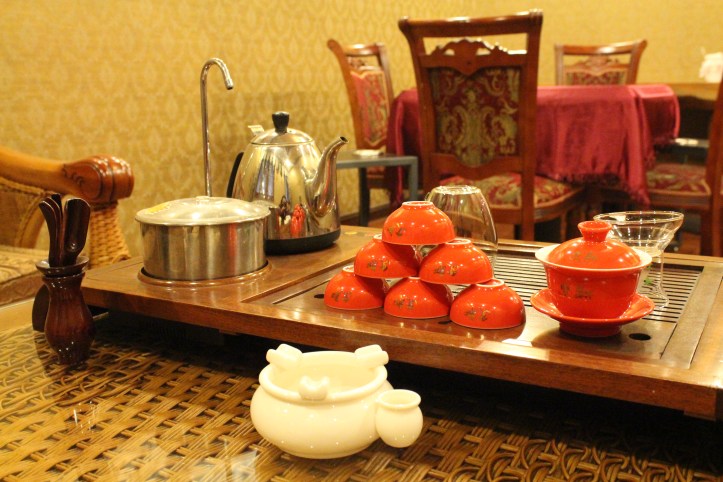
During the stay in Xinyang, I walked into a Wenxin Tea House and ordered a cup of regular Maojian tea for RMB30 (AUD6.25). The house also provided a complete tea brewing set.
Home of Maojian tea
Xinyang has a mild climate amid abundant forests, clouds and rainfall. With big temperature dips between day and night, the more delicate Maojian tea are planted at higher altitudes where weather is even more distinct.
Many high mountains for tea production, such as Cheyun Mountain, Jiyun Mountain and Tianyun Mountain, also offer adequate humidity and moisture that ensure a healthy and fertile foundation.
Spring and fall are the harvest season for Maojian tea. However, leaves that are harvested in mid-April make the best of it. This is often referred to “Ming Qian Tea”, which literally means tea from pre-Qingming Festival. It is also called “Yu Qian Tea” in some parts of China, which means tea from the pre-rainy season.
The leaves plucked during this period are rare and fresh. The price is also much higher than the tea produced after this season.
History of tea in Henan
In Henan’s history, tea has long played an important role.
China’s tea production first developed during the Zhou dynasty (1066 – 221BC) which had its capital in modern day Luoyang in Henan province. Originating in the southern part of China, the culture of tea-drinking spread across the country over the following centuries with political and economic growth, cultural interaction and communication.
By the time of the Song Dynasty (960 – 1279) which had its capital in another city of modern-day Henan, Kaifeng, tea had become an important crop in China.
Henan’s history of cultivating tea trees was recorded in ancient texts. In the Book of Tea, the world’s first book dedicated to tea from the Tang dynasty (618 – 907), it is written that “Tea culture followed transportation movements settled in Henan’s Qinling Mountain. Because of weather conditions, trees could no longer be pushed northward.”
In the southernmost region of Henan, the city of Xinyang proved right for tea production, from terrain to environmental conditions.
In 1987, tea was found in ancient tombs at Gushi county of Xinyang. The tea was determined to be made in 875BC, which puts Xinyang’s history as a tea-producing region to more than 2,300 years ago.
Today, tea continues to thrive in the region.
 The Tip Box
[…] because the numerous tea houses were too hard to miss. They serve the area’s best kept secret – Maojian, which is among the top tea in […]
LikeLike
[…] are small cafes and traditional tea houses at the resort, where tourists can enjoy a cup of Maojian tea and have a chat with other visitors or local […]
LikeLike