We live in an interesting time of human history. We are connected with one another more than ever on social media, and yet, we are increasingly divided among ourselves.
Take America as an example. Donald Trump’s win at the presidential election was the result of a divided America. The signs were clear on social media before the election:
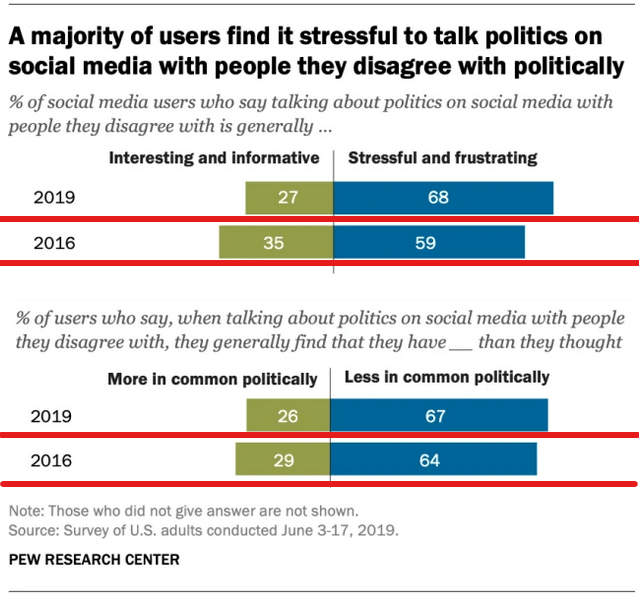
And it is getting worse for the upcoming election in 2020.
While Americans have been raging over Trump’s presidency since late 2016, the Chinese have battled over Hong Kong protests on social media throughout the second half of 2019.
I was caught between two worlds on this. My Chinese friends unanimously supported the Chinese government and the Hong Kong police, labelling the protesters nothing but a trouble-making mob. My friends in Hong Kong took a firm stand that went in the opposite direction. Right here in Australia, mainland Chinese and Hong Kong communities rallied behind their own groups back home and clashed with each other on the streets.
Meanwhile, Singaporeans had no stomach for the unruly behavior and showed distaste about the protests. Then Hongkongers said that “Singaporeans do not understand the situation“.
As clashes in news and on social media intensified and became difficult to watch, I remained silent about Hong Kong, a city I enjoyed staying in and liked very much. Because whatever I say, it will be seen as I’m picking a side or probably worse – no side.
Yes, there are only two sides but no middle ground about the Hong Kong protests, as with many things that are talked about on social media these days.

How did we get here?
The main cause of this “social division” lies in our human nature. It is natural for us to want to associate with like-minded people, and shield ourselves from potential conflict with those who hold stark different views on an individual level.
Before the age of social media, our interactions with people were limited to the vicinity we moved about. Our views were not instantly open to everyone for inspection. Allies were found based on both commonality and proximity.
Then social media changed it. It has given us a convenient platform to seek our own communities and form alliances. We may not share the same views with our neighbors or co-workers, but we can “socialize” with those who do on the other side of town. Human nature dictates our tendency to interact more closely with people who share similar ideology.
It has also made it easier to express our opinions – however polarizing or scathing they are – without worrying about in-person discussions with the opposing side that may get uncomfortable or confrontational.
Furthermore, social media has become so pervasive in our lives that it has built up the sense of FOMO among us. There are incessant Facebook posts, tweets, WeChat Moments and Weibo that discuss everything in our daily lives. Sometimes, we feel compelled to participate in the trending topic and the urge to say something about it too, or we are seen as outdated or indifferent.
Then suddenly, everyone had an opinion about everything. No matters are too trivial, no topics are too sensitive.
I have stayed away from talks about politics, religion or race, but I often get disturbed by the movie reviews that are negative in the extreme. (I talked about this in a previous post – Dreadful Search for A Good Movie.)
More often than not, different voices converge in two camps. Especially on sensitive subjects, a line is drawn quickly and it leads to an either-or situation – people are either with it or against it, and the two sides are instantly at loggerheads. As what I’ve seen in the social posts about Hong Kong, some of them were more about making a stand than believing in the cause.
The result is a gaping schism in the world we live in now, which ironically, has never been so connected.

The question is: will the situation exacerbate or get alleviated? Will we continue to stick to our own clans in the virtual world, or will we quit bigotry on social media and exchange our views more openly?
The future holds the answer to that question.
 The Tip Box