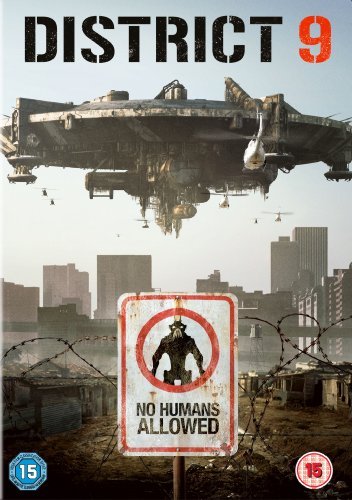
Other than a stamp of “Peter Jackson Presents”, there are no A-list stars nor a super director in District 9 (2009). Its production budget is small – only US$30 million. However, the sci-fi fantasy became a big commercial success at the box office.
 All photos are from IMDb’s gallery.
According to Box Office Mojo, it took in US$115.65 million in North America and a total of US$210.82 million worldwide. It has also received rave reviews from critics. Entertainment Weekly says it’s “madly original, cheekily political, altogether exciting”; Los Angeles Times calls it a “very smart sci-fi”; and San Francisco Chronicle remarks: “A science-fiction action vehicle so brilliantly and fully imagined that real life, when it resumes after the credits, arrives with a new sense of dread.”
The movie is visually splendid, with spaceships and aliens made by top-notch CGI appearing vividly before viewers’ eyes. Its intentionally-made documentary style creates an illusion of observing actual events, leading viewers to follow the angle of the camera and look through the lens as if experiencing it first-hand. But besides the technological awe and cinematographic techniques, it’s the creative plot that appeals to the larger audience.
The usual stereotype goes like this: aliens are more sophisticated and smarter than humans, since they have the ability to travel through the universe to reach our planet; they often pick New York, Washington, Los Angeles or any other major city to visit. Because as far as earthlings concern, aliens must have prior knowledge about which city on earth has the strategic value; and most of the time, they are never kind to humans.
This has been depicted by numerous blockbuster predecessors: Predator (1987); Species (1995); Independence Day (1996), War of the Worlds (2005), Transformers (2007)… But in District 9, the alien spaceship doesn’t come all the way here to invade the earth or annihilate human beings. On the contrary, the ship is somehow damaged and hovers above an unusual place – Johannesburg, the capital city of South Africa. Aliens are trapped in a refugee camp, unable to return to their home.
Most interestingly, though they possess advanced technology and weaponry, they fall victims to human abuses. Mercenaries intimidate them and sometimes beat them into submission. In one scene, an agent executes a defenseless alien in close range; a Nigerian gang smuggles food, drugs and even prostitutes into their territory, and trades them with alien weapons; the private corporation – Multi National United (MNU) desperately tries to harness the alien technology, studies their weapons and even experiments on live alien bodies.
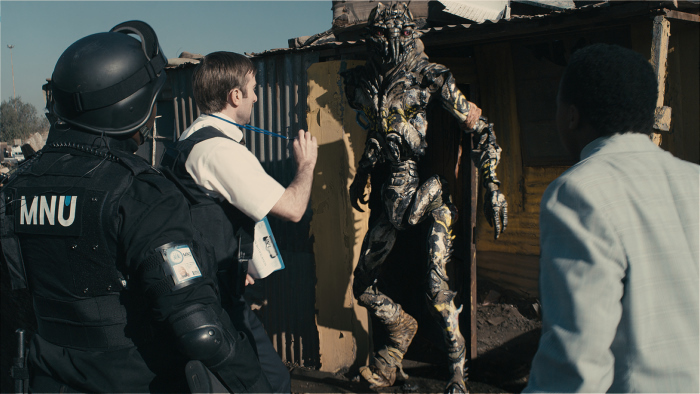
It is enough irony. To stress that irony, aliens in this movie have a repulsive outer appearance and a disgusting living habit. They resemble insects, with tentacles on their heads. “Prawns”, as humans call them disparagingly; they don’t dress up or preen themselves; they scour garbage for food; they are disorganized, leaderless and lack of disciplines; their camp on earth functions no less than a slum, messy and chaotic. Not the type of aliens we are familiar with, are they?
The protagonist of the story is Wikus, an employee working for MNU. He is having a rising start in his career, just appointed to head the operation to expel aliens. He initially despises the aliens, calls them “prawns” like everybody else; hands out paltry food to them as if giving out big rewards; destroys their hatching devices just like killing cockroaches. But as the story takes its dramatic turn, he gets infected by an alien object during the operation and is slowly turning into an alien. As unpleasant as it pans out for himself, all the people around him are turning against him. His friends shun him; MNU sends out agents to hunt him; the media spreads rumors that his transformation is the result from sodomizing an alien.
By this point, it’s interesting to see how fast his own species has abandoned one of their own and how magnanimous of the aliens not to kill him for revenge. In the end, he forms an impossible alliance with aliens, fighting alongside each other for a collective goal – survival.
There is plenty of dark humor. But that’s not the only thing the movie wishes to give: there is also a human touch in the story. Wikus nearly got himself killed for saving his alien ally; in the end of the film, he has fully turned into a prawn, but he misses his wife all the same. The last scene is a prawn picking out the metal scraps from a pile of junk, folding them into the shape of a flower, right after the scene in which his wife talks about the flower she picks up on the step of the house.

The main alien character – Christopher, though in an inferior life form, clearly has feelings no different from humans. He is upset to see his comrade getting killed and mourns when he sees the body lying wide open in MNU’s lab; he cares deeply about his son, whose safe return to their home planet is the sole purpose he serves on earth.
On many accounts, District 9 is an unconventional alien movie. But through the unconventionality, the story has brought humanity into focus. The refugee camp itself symbolizes the reality of the host country South Africa and the biggest problem the entire human society faces – inequality. Only in this case, aliens are the disadvantaged, while humans are the privileged. It speaks the truth about human nature, evident in the history of civilizations: where there is an imbalance of power, there is exploitation. However, it also underscores the best quality in men: the ability to sacrifice and the driving force for change – love.
 The Tip Box